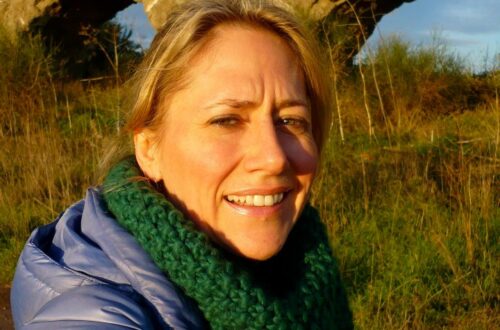
Interview with Poetry Editor Monica Sharp
Published in Open Doors Issue N. 5 Dec 2023.
Monica lives and writes in Florence, Italy. Her international spirit travels with an American passport. She moonlights as a legal researcher when not parenting, managing projects, or writing. Her writing has been published in Across the Margin, Mediterranean Poetry, Bosphorus Review of Books, Fevers of the Mind, The Florentine, Rome-ing: Firenze, Adamah, and Synapse. Find out more at sharpmonica.com.
Lauren: Ciao Monica! As the poetry editor of Open Doors your perspective and support has been invaluable to the magazine and now I’d like to talk about you. Can you tell me about your own writing journey? When did you start and what kind of writing do you do?
Monica: Almost as soon as I learned to read, I wanted to write. My parents gave me a blank book for Christmas when I was seven, and it was a revelation. I wrote in that blank book every day with a peppermint-scented pen.When I was eight, I had a poem about winter snow published in the local paper in Traverse City. I was so proud of this. The following summer I found myself writing plays for puppet shows at day camp.The writing just kept coming. Short fiction, poetry, essays, CNF. I published more poetry as a teen. I was the yearbook editor for almost all of high school and if my staff could not write the copy in time to meet the deadline, I would do it myself. I was a machine. I learned early the importance of fact-checking when I fabricated a headline for the Spanish Club page. The teacher was furious. My Spanish as written was basically invented. I was horrified at what I’d done. Meet deadlines, but correct your own work.
In my mid-twenties I tried to make a go of it professionally as a creative writer but got snared in both life and logistics. Certain shortcuts didn’t work, after all. And
I didn’t have an MFA or an annuity. I was hired in the nick of time by a software company in Seattle. It was soul-numbing and offered ample material for fiction and more. (Featured in my most recent published piece, “Corporate Duck Duck Goose.”)
My creative writing took a back seat for a couple of decades as I waded into the deep end of a professional career, and rather than writing poetry or short fiction found myself battling a flaming email inbox each day. I continued journaling until I was thirty but then that tapered off too as life settled into a routine of career and mar- riage.
But I was miserable on a deeper level. My creative life went woefully neglected, sacrificed to professional success. About ten years ago my husband and I came to Tuscany for a year of professional secondment, both of us teaching and working for a local academic program. We lived in Arezzo with our toddler son; I made some important friends who encouraged me to take up the banner again and write. Since then I’ve been writing constantly. It’s a proven release valve for the slings and ar- rows of life, and living in Italy offers me abundant inspiration, both internal and external, to both notice more and to write more.
Starting in 2018, I began enrolling in online writing classes here and there. Noth- ing too big or expensive, but if an author or a website offered something, I would
do it. This helped me find both a global community and kindred spirits. I have always wanted to write for a reading audience. I was never a suffering soul. In 2021 a literary magazine in the UK (Adamah) contacted me to ask if they could publish an essay I’d written and placed on my website. I was surprised and delighted and of course consented on the spot. But this made me realize, if publications asked me for my work, then it was probably time for me to start submitting my work more wide- ly. In the past two years, I’ve been doing that off and on, and now have a nice roster of published pieces. (See: https://sharpmonica.com/publications/.) I’m humbled everytime an editor gives me a green light because I know how many talented writers are out there in the world, writing and submitting. As soon as I stopped viewing it as a competition and start- ed treating it as a community to cultivate, I really began to enjoy submitting more.
I am a massive bookworm and feel that if I can just give back in a fraction to the greater world some of the benefit, comfort and company that reading has given me, I will have paid an important karmic debt.
Lauren: That’s a wonderful way to approach writing. Sometimes I can get lost in my own grand schemes for my writing but I like this more generous approach. What is your writing routine (if you have one)?
Monica: I usually write in the mornings between eight-thirty and ten, after school drop-off and before heading into the office where I work locally in Florence. Late afternoons seem best to me for submitting energy.
Evenings are given to reading. If I can’t sleep at night I’m usually composing a poem in my head to get a ticket back to dreamland.
Lauren: Describe a breakthrough you had with your writing – either in terms of discipline (discovering a routine worked for you or not) or it can be related to form.
Monica: Having that first literary magazine contact me first to ask if they could take my writing pieces, and then to do so again and again, really boosted my con- fidence and led me to see my own writing in a new light. So did my writing com- munities – I belong to two international writer groups on Slack, and one web-based group out of South Africa. We write prompts, meet to write, and offer critique. It’s incredibly valuable to me to have like minds to bounce ideas off of.
Lauren: I agree. And sometimes that community can come fellow writers and from the authors we read. What are some poets you think are particularly helpful to read for inspiration or instruction?
Monica: Emily Dickenson. Sylvia Plath. (Shameless plug: see “Dickinson” on Ap- pleTV!) Mark Strand. Louise Gluck and her protegé, Max Rivko. Larkin. Keats, oh my lord Keats! (See: “Bright Star.”) I like David Whyte and often dip into his regular seminars. I loved Shel Silverstein as a kid. I also owned a huge poetry anthology that I pored over when I was young. I like the old poets too: Ovid, Catullus, Sap- pho, Horace; Virgil and Homer in translation. (Classics majors, ride or die!) Dante, Petrarch, Villon.
Poetry in Spanish. Lorca, Pardo Bazán, Neruda, Mistral, Paz, Vallejo. Darío, Valle- jo, Cortázar. Sor Juana Inés de la Cruz. Antonio Machado and his beehive. I read Spanish literature for my masters degree and loved it all, both before and after.
Lauren: And turning from reading to writing: What are your top three tips for someone submitting a poem to a publication?
Monica: Make sure you’ve put it through at least five to ten drafts or more, and if you can, share it with a literary friend for feedback.
Jane Hirschfield claims that everyone on the planet has three good poems in them. Make sure you’re scratching the surface. Humans tend to have similar feelings and write about similar themes.
Speaking of themes – make one evident in your submissions. Have an arc, a run- ning thread. Submit to themed issues. Don’t submit summer poems in winter, and vice versa. Pay attention to the calendar, the seasons.
Critique your own work relentlessly for originality. Critique everyone’s work – in- cluding your own – with kindness and insight.
Poems are relatively short. Make them count.
End on a note that sticks with the reader. There should be some original energy, ob- servation, or angle at the end. Tie it all together or blow it apart, it makes no differ- ence. But finish memorably.
Lauren: When does a poem not work?
Monica: When content is banal. Literary themes (life, death, love, longing, etc.) are evergreen, and rightly so, but even original poets succumb to cliché if they’re half asleep at the pen. Be awake and make your words breathe. Take the reader some- where new, or somewhere familiar with new eyes. Illuminate a darker corner. Re- veal what needs to be known.
Lauren: What is the best writing advice you’ve ever received or come across?
Monica: Risk and persist.
Everyone has a story worth telling, but many give up before the telling is finished, or even begun. In the words of the great Octavio Butler, there is nothing new under the sun, but there are new suns. Don’t underestimate the power of your own indi- vidual experience, freshly recounted.
I respect those modern prophetesses of writing technique and its attendant philos- ophies: Goldberg and Lamott. I light a candle to each of them for inspiring and nourishing me when I was younger; their encouragement has stayed with me for years. I also remember a lovely book about writing craft that I read pre-Y2K called One Continuous Mistake by Gail Sher. The Buddhist approach to writing resonates for me. Chop wood, carry water, write, repeat. Practice makes poems.