Interview with Author Flavia Brunetti (English)
By Charlotte Cicero. Published in Open Doors Issue N. 7 June 2025.
In honor of the 2025 Florence Literary Society Publishing Day, Open Doors will be publishing a series of interviews during the course of 2025 with authors on just how they went from manu- script to publication.
Open Doors intern Charlotte Cicero sat down with Rome-based author Flavia Brunetti to discuss her path to publishing and her new book The Web of Time. This interview took place on Instagram Live, you can watch it on our instagram page: @opendoorsreview.
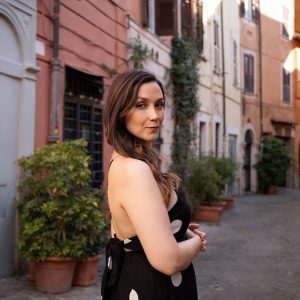
Photo credit: Haizea Mariti
Hello everyone! Welcome – my name is Charlotte Cicero, I’m currently studying abroad here and Florence and working as an intern with Open Doors —I’m so excited to host this interview live with our special guest today and can’t wait to get started!
Today’s event is part of our 2025 series of interviews based on publishing —this is in celebration of the upcoming “Publishing Day” created by the Florence Literary Society.
Our first interview was with Tiffany Parks in our last issue, and this interview will be featured in Open Doors’ upcoming issue, which you will all get to see this May!
So now introducing our special guest today…. Flavia Brunetti was the 1st guest judge of Open Doors Review in 2020 and the author of All the Way to Italy Flavia’s NEW book, The Web of Time which is published by Blue House Literary, comes out on May 20th and is available for pre-order now! Plus, Open Doors will be publishing a chapter in our upcoming issue! Flavia, welcome and hello!
Before we start here is a quick synopsis of this book, which I am SO excited to read:
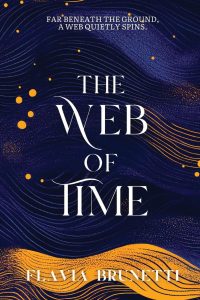
“Protected by the gods and powering the three Great Portals of Kindness, Art, and Language, The Web of Time rearranges itself as humans change their minds, fall in love, or cause empires to rise and fall. When the Great Portals close from the world, time begins erasing itself, histories start to disappear, earth falls into chaos, and the gods don’t know how to stop it—until Jack meets Anna. Anna is a passionate and solitary writer who is protected by her companion, Nafusa of Libya, the cat god. When Jack, a young painter harboring a traumatic past, falls through the Great Portal of Art in Tunis, he stumbles into Anna and his fate. Helped… and hindered by a rotating cast of deities, the two embark on a journey that connects three an- cient cities in different times: Rome, Tunis, and Tripoli. They realize that it is Anna’s gift for healing words and Jack’s natural talent for drawing places as they were, that can reinstate the Great Portals and restore the world’s balance…. but some of the darker gods who thrive on chaos will stop at nothing to derail their quest. As time tears faster than they can heal it, Anna and Jack must come together in time to save history, and the possibility of a future.”
Charlotte: How do you fit in a writing schedule around your work life?
Flavia: Oh we’re gonna start with the hard questions… I think it’s one that we all struggle with regardless of what walks of life we’re in or what other jobs or things we do in general.
This can be a challenge no matter what. And for the record I don’t always get this right, it’s not me and my high horse… what has helped me so far has been I think, compartmentalizing. I try to be as present as possible in whatever I’m doing at the moment, it’s been serving me really well. Sometimes we can feel like our attention is being pulled in a million different directions. If I’m working, I try to be there in that moment. I’m better off if I leave an hour in the morning to just write, so I leave my- self time to do just that. I think it all feeds into the writing element. So I try to leave time for things like taking a walk – that really helps me if I have writer’s block, time to rest, and spend with friends, and I also have to-do lists that are a mile long. And I’ve learned that If I do one or two if I check them off, I consider it a victory. What’s helped in the balance of it is leaving time for certain things, making sure that I’m present, and not giving myself such a hard time. I’ve seen this a lot, especially with the women in my life we give ourselves a really hard time when we’re doing so many things, to take stock of the victo- ries. I think it’s important to see everything as a victory.
Charlotte: Absolutely! A per- spective that came to mind as you were talking about that is—if you looked at all the things you accomplished in a day completely separate from your to-do list you made in the morning, you’d say, “oh my gosh I really did get a lot done today”—rather than think- ing about all the things you didn’t get done. How is The Web of Time different from your other works?
Flavia: It was a completely different genre, my first young adult and my first fantasy book, my first book All the Way to Italy was also fiction… it wasn’t fantasy, but a piece of the idea for The Web of Time came out while I was writing All the Way to Ita- ly—I really wanted to personify some of the parts that were really important. And so I knew I wanted to write a fantasy, which All the Way to Italy isn’t, so that’s how it’s different… but it also stems from my previous work. I also write shorter pieces, one of which Open Doors published, which is a little easter egg to The Web of Time. It’s different in the way it expresses itself, it’s a longer form of writing. It has elements that creep into all of my work, Rome first and foremost, but then a series of other things, grief, hope, and loss, finding ourselves again, and all of the different cultures we all encompass. We all bring all of the places that we’ve been to the things that we do.
Charlotte: I love that, that’s amazing. What research did you do for this novel, pre- paring to write it?
Flavia: So the research element was substantial for Web of Time but really fun. The idea for it came from my travels and what I really do, so Rome and Tunis, and Tripoli, are all cities I’ve spent a lot of time in. Tunis and Rome I’ve lived in, Tripoli I haven’t had the privilege of living in yet, but I spent a lot of time there, so a lot of my ideas came from these different places. I also really wanted to add—that as the story fleshed itself out—it was important for me to be historically accurate. I think probably be- cause also I hang out with a lot of tour guides, and I think everybody would have been upset had I just taken creative liberties, historically speaking. I think that you can take liberties with history, but you have to be purposeful about it. So a lot of the research I did revolved around the historical pieces that are in the book and to make sure that what I was saying was historically accurate—there are pieces that are in dif- ferent parts of the cities; obviously Jack and
Anna spend a lot of time engaging in and
around those places, and I really wanted it
to be true. I think that was a lot of the re-
search element, a lot of ancient Rome, they
go back through time so a lot of the story
takes place in different areas that needed to
place themselves in a historically accurate
way. A lot of the myths surround the differ-
ent cities, and I had a lot of fun when I was
creating this ‘pantheon of gods’. Some of
them I made up, ones I knew I wanted to be
gods of places, but some of them come from
history, so I needed those to be named. I
got to do a lot of background research, the
different types of gods and the different cultures that call them, it opens up a whole world, which is really very cool, and that’s the privilege of getting to be in cities like Rome, Tunis, Tripoli, that are so strongly located in history, but in a way that they have brought into modern times.
Charlotte: I am also from Northern California, so reading your profile I’m so in- terested to know how you take elements from all the places you’ve lived into your writing style, specifically your lived experiences in Rome, Tunis, and California, and how they differ or are similar?
Flavia: So it’s really good to hear you’re also from Northern California, I spent be- tween the ages of 3 and 19 there. So I used to feel very American. My lived experi- ences have very much colored The Web of Time and All the Way To Italy. I think the Web of Time comes from the lived experiences of Rome, a city that I carry with me all the time, no matter where I go. Tunis was a city that when I first went, it felt su- per alien, like nothing I’d ever seen before, except it was strange because it was only 45 minutes from Rome by plane, but then it slowly became home. The same thing happened in Tripoli, the more time I spent there and with the people there…also ev- eryone loves Italians, everyone’s always happy to talk to you about the food that they have that’s similar or different, the languages, and I think one of the first times I was comfortable in Libya was when one of my colleagues heard me speaking in Italian over the phone and said “you know in Libyan, I recognize some of the words, we use Italian slang” so we started talking about how these things are similar and how they are different, actually that’s where the idea for the portals came. The three portals are kindness, art, and language. My lived experience has been that those are the things that connect us. That’s when you start to realize that the things that bring us together are so much stronger than anything that could try to tear us apart. And with Tunisia, I spent 4 years living there, it’s firmly ensconced in my heart, so is Libya, very much so and I had this fascination with Libya with the Nafusa mountains and so of course one of the gods, that’s one of the main characters in The Web of Time is Nafusa and he’s a god of the Libyan mountain range. A lot of the settings of The Web of Time are set in areas of Tunis that I lived in, some of them are set in a place that one of my best friends is from, who I based one of the goddesses on, and then of course Rome. Rome colors everything I do. I think I’ll always write about about Rome, whether it’s fantastical or not, she’s in everything I do. I think that’s always going to be the case.
Charlotte: I love that, Rome is so beautiful. I’ve only been twice, but Rome is like one of those places that you are just in and you’re like, “woah”. You’ve lived in Tunisia as well, which is featured in your book – are there any other nuances and little memories from living there that can be seen in this book?
Flavia: So many! I’ve peppered The Web of Time with the places that I really left my heart in in Tunisia. Where Jack’s father lives, is called La Marsa, it’s where I lived when I was there, I lived right by the sea, and so those four years for me are colored with the sounds and colors of the sea. Living there, I could literally see the Mediter- ranean from my kitchen window. I got to see the sea in all of its moods. This is how Dora is, the Goddess of the Mediterranean; and she is very much like her water, she is incredibly kind and devoted, but at the same time, if you make her angry, she be- comes like an ocean. So I think that is something I took with me and brought into The Web of Time, there’s a point where Jack is walking between La Marsa and Sidi Bou Said which is a very famous area of Tunis, and those are walks that I used to go on with my friends and my colleagues. Every time someone would come to visit me in Tunis, that’s where I would take them. There are places that really stay with you. The locations of the books – the Ennejma Ezzahra is a really important place in The Web of Time and it’s a palace that is in Tunisia. It’s part of the reason why, and my publisher likes to say, it’s a really good book for ‘armchair traveling’. All of the places are places you can feasibly visit. Areas of Rome, different places in Tunisia, and Libya can be less so, it’s not always as open to tourists. But sometimes it is, I hope that it can remain a stable context and we can go visit it more. One of the things I saw when I was in Tripoli, they have Roman ruins that are completely untouched, because there’s not as much tourism there. And there are just these incredible pieces of history. Like the arch of Marcus Aurelius in Tripoli, that’s also one of the main places in the book. It’s another connection between all of our histories, it’s another way we’re all coming from, we all have shared experiences, cultural cross-polli- nation is something you see every- where you go.
Charlotte: I love that phrase “cul- tural cross-pollination”… just the way you described that all makes me want to go ‘armchair traveling’ as you mentioned. Is there anything you took from your novel, All the Way to Italy that you brought into The Web of Time?
Flavia: I think the first example that
comes to mind, there is Sira who is
a main character in All the Way to
Italy and she is the personification
of my aunt. My aunt raised me, she
was the most important person in
my life, and Cira is a different character in The Web of Time. She is the most power- ful goddess in Rome, in the end, the city is hers. That is because in everything that I write I will always bring my aunt and my family into it. I brought her into The Web of Time as a goddess of Rome because that’s what she was. She, and my other aunt, were the first ones to encourage my being a writer. She supported me hugely. That’s the gift that they gave me, so everything I write is sort of an ode to them.
Charlotte: Talking about your publishing journey, can you walk me through what it was like getting your publisher for The Web of Time?
Flavia: So many of the people that I speak to, my fellow writers, struggle with a sim- ilar adventure of finding what we want to do with our lives. I am a big advocate that nowadays there are so many things you can really do. I ultimately wanted to go with a small, independent press. The reason I wanted to do that, was that I really wanted someone who believed in the book the same way I believed in it. Someone who would be able to spend time on it, but something where I got to be a part of the process. I really wanted a back and forth, where we would exchange thoughts. I say this always, it’s a give and take. It took a really long time, any form of traditional publishing is just kind of a long game. I really wanted to make sure The Web of Time found the right home. When Blue House came around, it was the right fit and it has been. The big takeaway for me is to trust your gut. I say this as someone who struggles with fear all the time, if something doesn’t feel right, don’t settle if it’s your dream. If it’s something that you really want to go a certain way, that doesn’t mean it has to be the original way you planned it. It is worth it. It’s almost like a relationship. If you’re in a relationship and it’s not the right fit, you know it’s not the right fit. And there is the right fit out there. And if you don’t let go of what’s not right for you, then what is right for you doesn’t have the opportunity to come in.
Charlotte: Yes! I heard a quote the other day that was just like this…. “You can’t re- lease what doesn’t serve you until you realize it doesn’t serve you”. I think that’s very similar to what you were talking about. I’m excited to see those values in your book, and relate them to our own lives. People are going to feel so much and really take a lot away from your writing. This will be our last question of the evening, What’s some- thing that’s a deal breaker for you when looking for publishers or agents and what’s something that stands out for you as well?
Flavia: I think this can change according to what you want, but if you’re at least clear on what you don’t want, that can help you find the right fit. Like we were saying be- fore, for me it was really important to have a publisher that felt like a collaborative process. I wanted to be a part of the cover, and the summaries, I wanted to be heard. But at the same time, I recognize how important it also was that I listened. Because they are the experts, there’s a give and take, like in a good relationship! You know, The Web of Time is my baby, in the same way whenever we write something, it’s our baby. When you hear suggestions sometimes, immediately you’re like “No no no this is my baby” … but you do really have to hear what they are saying. You have to be editable. I think there’s just a line, and for me, it was really important to find a publisher where that line was respected. This means you come to me and you say “Listen, there’s this piece what do you think, can we adjust or remove?” and I make the commitment to say “Okay I hear you and I’ll think about it” and if I want to, I make that change or you express that “it’s really important to me that this stays this way” and you find a common ground. Blue House is like that. They don’t tell you what to do, they come with suggestions. We’re all editable, and we can all be better writers and better cre- ators, but sometimes you have to protect your characters. It really depends on what you want; it’s good to be clear about what you want, maybe even more about what you don’t want. The thing that would take me away from a publisher, is if they don’t hear you. This is a really competitive field, and there are so many publishers that aren’t necessarily professional. It can be really hard for a writer to stand their ground. For that, my community has been really useful. I have an incredible editor, who I’ve been able to go to throughout this process and say “I feel this way about this, what do you think?” and I think having those people in your life is really important because you need people in your life that are calling you out when you need it.
Charlotte: Absolutely – well that was our last question, anything you would like to add?
Flavia: Yes!—the book is available for pre-order, I’m doing an incredible partnership with this language school Natakalam, and they are offering a 15% coupon for their language courses, all their teachers are from conflict-affected communities. We are having a launch on May 29th, which will be a free event! We’ll talk and go more into this topic of “cross-cultural pollination” and do a reading from the book.
Charlotte: Well Flavia thank you so much for letting me pick your brain, I can’t wait to read The Web of Time, and thank you all so much for joining us today—again The Web of Time comes out on May 20th and is available for pre-order now! Flavia thank you for being here!
Read an excerpt of The Web of Time on page 52: “The Great Portal of Art.”