Letter from the Editor: OD N. 6 Dec 2024
By Lauren Mouat. Published in Open Doors Issue N. 6 Dec 2024.
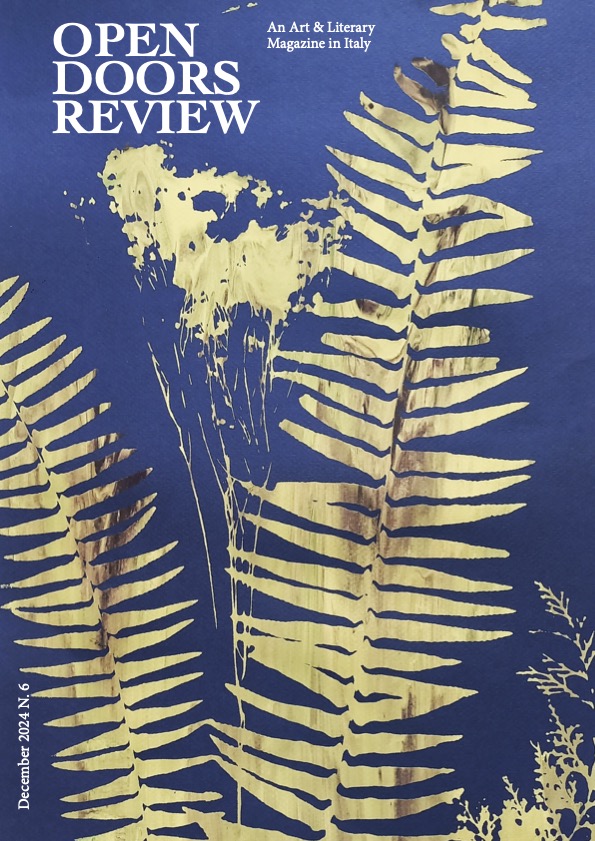
The word inspire comes from the Latin “inspirare” which meant, like the current Italian ispirare, to breathe. Only in medieval times did the word take on the mean- ing of “divine guidance.” The writer’s search for inspiration – that stimulation that urgest you toward the act of creation – can feel daunting, awash as we are in a del- uge of images, flashpoints, memes, jokes, sketches, skits, cat videos, etc. But I like to remember the ancient orgins of the word – a guidance from an otherwordly, divine source, coming to you as simply as as a breath of air. We take in sights, memories, experiences, and we breathe out art.
The works in this sixth edition of Open Doors are a roadmap to the varied doorwys to inspiration. Jack Stewart takes us to the Non Catholic Cemetery in Rome in his poem of the same name while Jacky Stephenson evokes Ravello in Poesia Ai Rav- ellesi. Cole Henry Forster brings us to Rome in three poems and Nancy L Weber’s Luck has us contemplating the nature of chance and strategy in a beach side amuse- ment park.
Language and form are the starting point for Emma Prunty’s The Poem, Chloe Yelena Miller’s Italian Vocabulary and Ron Riekki’s Sonnet.
Two essays take us into the world of authors and directors in Giorgio Fontana’s Our Need for Stig Dagerman and Jack Wardynski’s Italy behind the Lens about Ital- ian filmmakers Paolo Sorrentino and Luca Guadagnino.
A discovery in her own building of a french book of memoirs led Monica Sharp to create a delightul translation that sheds a new and delightful perspective on young Napoleon.
Throughout the issue, we are honored to display a variety of works from Tatiana Stadnichenko which reveal the artist’s connection to place both archiectural and the healing quality fo nature.
Books, poems and paintings provide a foundation for Nathanial Cairney’s I fianlly get Noah’s Ark, Priscilla Atkin’s Pierrot and Stephen Campiglio’s Daimon.
Memory seems to be the source of inspiration for Mark Anthony Jarman’s Twa Corbies, Martin Pedersen’s Clean Scan, Irene Mitchell’s Direct Action and Use- ful Knowledge, Timothy Houghton’s More by Fear and Jonathan Vidgop’s Meat. Although as a fiction author myself, I wouldn’t presume that events described nec- essarily “happened.” The truths of fiction more often come from a story or poems vicinity to memory rather than a factual retelling of events.
In the case of K Eady’s Havaianas, it was a writing prompt at the monthly gener- ative writing activity in Florence that was the jumping off point – a prompt itself gleaned from a New York Times experiment in which they proposed a list of words to both a real author and AI to produce a “beach read” with interesting results (dis- cussed as a foreward to Eady’s story.)
That AI will replace and parallel many human pursuits seems inevitable but the idea that it will sideline human creativity or lead to the end of writing our own works and reading the creative work of our fellow humans to me is simply impos- sible. As long as we breath, we will in one way or another create and share and in sharing, create… and on and on. To breathe is to be inspired.
-LTM